"Carrying the crack" == Cain. (321)
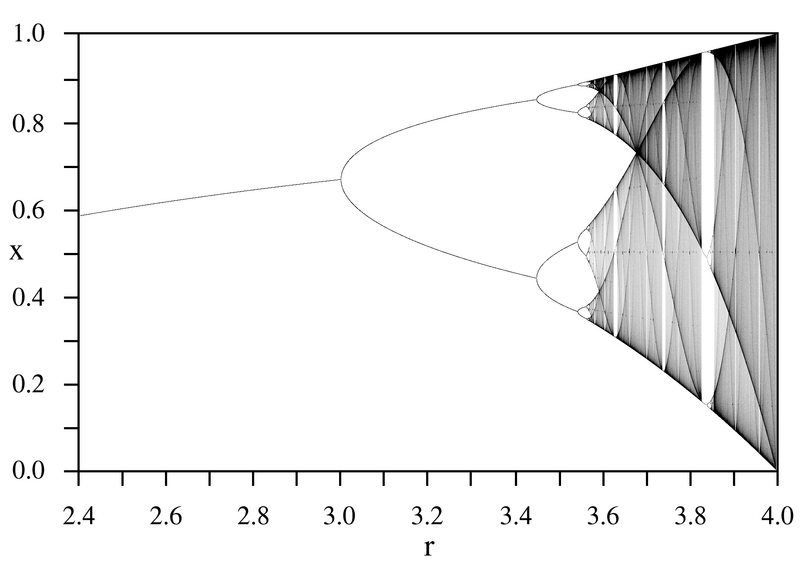
The crack is "continuous, imperceptible, and silent." (324) It is Aion. It has a heredity (cf. Foucault's genealogies). (324) Like a gravity well or gyre, the crack "follow[s] the lines of least resistance" along an "oblique line" (read fibonacci numbers in Pascal's triangle). (325) Compare to logistic map.
"The crack...--the appetite for oil". (330)
D speaks of the small heredity reflected in the grand heredity, the small maneuver in the large maneuver. (331) Compare to the Sierpinski triangles within the Pascal triangle, also the two levels of the Baroque House.
Monday, October 17, 2011


Friday, October 14, 2011
Appendix II: Phantasm and Modern Literature: 4. Michael Tournier and the World Without Others
"Must we conclude that sexuality is the only fantastic principle able to bring about the deviation of the world from the rigorous economic order assigned by the origin?" (303)
"If it is true that neurosis is the negative of perversion, would not perversion, for its part, be the elemental aspect of neurosis." (304)
"The pervert is not someone who desires, but someone who introduces desire into an eintirely different system and makes it play, within the system, the role of an internal limit, a virtual center or zero point." (304) Essentially, introducing a new (pre-individual) singularity.
Page 305: Without the Other, I am groundless. The Other is the button in the sofa holding the stuffing in place.
"[The Other] makes things incline toward one another and find their natural complements in one another." (306)
Page 306: On the origins of narcissism. Without the Other, "Everywhere I am not total darkness reigns."
Page 306: On why things bang.
Page 307: There is a generalized relativity of others.
"The Other...is the expression of a possible world." (308) D talks of Proust perceiving Albertine on the beach and what it meant to him and what would it mean to her if she had seen him. (308) This is exactly the point made earlier between language and bodies: That the structure, the geophilosophy of the real, any arrangement of bodies (the scaled up version of one body perceiving (an)other) will benefit from decoding (as with a hieroglyph) because entire worlds are enclosed in these perceptions; to have viewed this person on this day says something more than just our subjective reaction -- there is a structurality to the real which is both beyond us and demarcated in our very own DNA. It is in this "reading" of the real that we find that we are co-extensive with everything around us (e.g. Robinson's goat Friday, "Everything is Everything", the foot fetishist finding real amorous love in a foot, etc.).
Page 308: The crucial split between monism and dualism, the basis for the split between Deleuze and Lacan-Hegel, univocality vs. dialecticism, etc.
Page 310: Annihilation of subject by object and vice-versa means the inversion of the gyre within the Pascal diagram. There is a moment of immanence in that annihilation, however.
Page 311: During immanence, "error", the remainder, has been reduced to zero. The GCD is common to two numbers simultaneously. Madness is where one is immanently connected to everything.
Page 311: Inability to find the cracked-ness in ourselves --> Groundhog Day.
"The desert isle initiates a straightening out and a generalized erection." (312) The process of the eternal return. The gyre, the black hole, at first breaks the world down chaotically, but is then productive, poetic.
Page 312: On doubling and the Event; the elemental generative act of the multiplicity.
On the GCD/BwO/"liberated double": "The new upright [rectified] image in which the elements are released and renewed, having become celestial and forming a thousand capricious elemental figures." (312) Compare this to the constellation, Bush I's "thousand points of light", "an arrow aimed at a heart", etc. This double is like a gateway, a black hole to another dimension: "It is as if the entire earth were trying to escape by way of the island." (312) Via the event, the constellation changes from a 2-dimensional picture into a 1-dimensional line (the straight-line labyrinth, "vertical without thickness", the Red Queen). It becomes an "upright organization as opposed to a recumbent organization". (313) The "detachment of the pure element" is of course the Aion. (313) This event, though productive and affirmative, can also be associated with catastrophe, an apocalypse of meaning, "everything has lost its sense". (313, 315) Liberation comes with catastrophe, a release from the torrid depths and a "return to [and discovery of] the surface," a rediscovery of the jouissance of (pure) immanence. (315)
Page 314: On hylomorphism.
Page 315: On the tradeoffs of depth and breadth and of their seemingly incongruous transmogrification between each state.
Page 317: The Double as seen as an extension of the Self.
Pure immanence (the discovery of the surface) is "a world without Others," "a world without the possible," for everything is (magically, euphorically, painfully) Real. (319, 321)
"If it is true that neurosis is the negative of perversion, would not perversion, for its part, be the elemental aspect of neurosis." (304)
"The pervert is not someone who desires, but someone who introduces desire into an eintirely different system and makes it play, within the system, the role of an internal limit, a virtual center or zero point." (304) Essentially, introducing a new (pre-individual) singularity.
Page 305: Without the Other, I am groundless. The Other is the button in the sofa holding the stuffing in place.
"[The Other] makes things incline toward one another and find their natural complements in one another." (306)
Page 306: On the origins of narcissism. Without the Other, "Everywhere I am not total darkness reigns."
Page 306: On why things bang.
Page 307: There is a generalized relativity of others.
"The Other...is the expression of a possible world." (308) D talks of Proust perceiving Albertine on the beach and what it meant to him and what would it mean to her if she had seen him. (308) This is exactly the point made earlier between language and bodies: That the structure, the geophilosophy of the real, any arrangement of bodies (the scaled up version of one body perceiving (an)other) will benefit from decoding (as with a hieroglyph) because entire worlds are enclosed in these perceptions; to have viewed this person on this day says something more than just our subjective reaction -- there is a structurality to the real which is both beyond us and demarcated in our very own DNA. It is in this "reading" of the real that we find that we are co-extensive with everything around us (e.g. Robinson's goat Friday, "Everything is Everything", the foot fetishist finding real amorous love in a foot, etc.).
Page 308: The crucial split between monism and dualism, the basis for the split between Deleuze and Lacan-Hegel, univocality vs. dialecticism, etc.
Page 310: Annihilation of subject by object and vice-versa means the inversion of the gyre within the Pascal diagram. There is a moment of immanence in that annihilation, however.
Page 311: During immanence, "error", the remainder, has been reduced to zero. The GCD is common to two numbers simultaneously. Madness is where one is immanently connected to everything.
Page 311: Inability to find the cracked-ness in ourselves --> Groundhog Day.
"The desert isle initiates a straightening out and a generalized erection." (312) The process of the eternal return. The gyre, the black hole, at first breaks the world down chaotically, but is then productive, poetic.
Page 312: On doubling and the Event; the elemental generative act of the multiplicity.
On the GCD/BwO/"liberated double": "The new upright [rectified] image in which the elements are released and renewed, having become celestial and forming a thousand capricious elemental figures." (312) Compare this to the constellation, Bush I's "thousand points of light", "an arrow aimed at a heart", etc. This double is like a gateway, a black hole to another dimension: "It is as if the entire earth were trying to escape by way of the island." (312) Via the event, the constellation changes from a 2-dimensional picture into a 1-dimensional line (the straight-line labyrinth, "vertical without thickness", the Red Queen). It becomes an "upright organization as opposed to a recumbent organization". (313) The "detachment of the pure element" is of course the Aion. (313) This event, though productive and affirmative, can also be associated with catastrophe, an apocalypse of meaning, "everything has lost its sense". (313, 315) Liberation comes with catastrophe, a release from the torrid depths and a "return to [and discovery of] the surface," a rediscovery of the jouissance of (pure) immanence. (315)
Page 314: On hylomorphism.
Page 315: On the tradeoffs of depth and breadth and of their seemingly incongruous transmogrification between each state.
Page 317: The Double as seen as an extension of the Self.
Pure immanence (the discovery of the surface) is "a world without Others," "a world without the possible," for everything is (magically, euphorically, painfully) Real. (319, 321)
Wednesday, October 12, 2011
Appendix II: Phantasm and Modern Literature: 3. Klossowski or Bodies-language
Explain: "It is our era which has discovered perversion." (280) What is perverse is the moment of deviation, declension, hesitation, stuttering, suspense, break, swerve, clinamen: "This differentiation never suppressing the undifferentiated [Aion] which is divided in it." (281) Hence, Sade was a geophilosopher.
Page 281: On the formation of the BwO, the "glorious body" from a "pure mind" at the moment of the Event.
Page 281: On the replacement of G-d with structure, geophilosophy, the Pascal diagram, etc. Our whole belief structure, our most holy ideals, including G-d, is now within the domain of the structure of the Event.
Compare Deleuze's writing here on seeing and speaking to his discussion in Foucault of Foucault's distinction between the visible and the statable, or the seeable and the sayable. (282) The point of the Pascal diagram is the same -- the Fibonacci spirals that make up the Pascal diagram can have a seeable shape or they can be spread out and elongated over a line like a pulsing vein (or an infinite straight-line labyrinth (Borges)). The event is this communication between the two forms, where we are converting the structure containing difference-in-itself from one form to the other. Cf. this post. "The function of sight consists in doubling, dividing, and multiplying, whereas the function of the ear consists in resonating, in bringing about resonance." (283) Compare here going up or down in the same (golden) ratio among the fibonacci series (the Pascal diagram, i.e. sight) vs. using an elliptical curve (sound, resonance between a hammer, anvil, and stirrup) to factor a number. Sight and sound are the two levels of the Baroque house which can actually switch or invert.
Page 283: On setting your perspective outside of yourself (cf. Buddhism). This multiplicative act of self is in fact the raw elemental Event at a personal level -- a self-division. The space between the multiplicative selves the potential energy whose release can be termed jouissance, but the content of which is the "idea of Evil". (284)
"Language imitates bodies...through flexion." (286) The point here being that geophilosophy and structure is not just an abstract metaphysical exercise. It is in the world; it is in the structures evidenced in literature, art, and film, which in turn have some basis in reality. This is the "reality" of Deleuzian space.
Deleuze, quoting the introduction to the Klossowski's translation of the Aeneid, "Words are...woven." (286)
Page 287: See this post for more on the return of the not-same. Repetition "authenticates the different." "Repetition is found in the intensity of the Different." (289) So when Deleuze says repetition "produces the only "same" of that which differs, within the Pascal diagram, we are talking about the GCD.
Page 288: On the gift and exchange as Event.
Page 289: Woman as pure intensity, difference-in-itself.
Page 289: Pure intensities are risings and falls.
Page 289: On the conversion from language reclaimed by the crystalline ("frozen") structure and made a "spiritual event" of it.
"There can be no transgression in the carnal act, if it is not lived as a spiritual event." (289)
"Repetition authenticates the multiple, and makes of it a spiritual event." (289)
Page 291: Quiet, silence, neutrality as a provocation to aggression.
Page 291: "Pure language" (e.g. fibonaccis) create thought (combinatorial conjunctions), while "impure language" (e.g. numbers that have not been fully reduced to their factors overwhelm the listener and generate "pure silence" (e.g. fibonaccis). As Deleuze cites Le Baphomet, "either the words are recalled but their sense remains obscure; or the sense appears when the memory of the words disappears." ""Pure silence surrounds words that are not "pure"". (300)
Page 292: On incommunicability, incompossibility, and the "privative function of a person". This says to me that like language and bodies, we all have our own person number built from primes which is unique and which we and others try hard to decode and re-encode every day such that we are not "assumed by a nature either inferior or superior to our own".
Page 292: On the incarnation of G-d vis-a-vis Jesus. The event as spiritual "treason".
"G-d is presented as the principle or master of the disjuctive syllogism." (294) G-d (later connected by Deleuze and Klossowski to Antichrist, Baphomet), like Aion, is itself difference-in-itself, pure intensity, an aleatory point.
Page 295: On reason (as a faculty, machine) vs. the categories/indices. (cf. Kant) This division enacts a paradox similar to What the Tortoise Said to Achilles.
Page 295: Free will is an illusion. There is no choice; G-d or the pure difference is the unmoved mover, the third man, the "master" of the disjunctive syllogism, arriving from out of a blind spot.
G-d == "the sum total of all possibility" == Aion. (295-296) Later, connected by Deleuze and Klossowski to Antichrist, Baphomet, G-d become the "prince of all modifications", "modification of modifications" (2nd derivative == affirmation of affirmation). (296) "Divergence and disjunction as such become the object of affirmation." (300)
"Intensities comprehend in themselves the unequal or the different." (297)
"All simulacra rise to the surface, forming this mobile figure at the crest of the waves of intensity -- an intense phantasm." (298) Cf. "A little bit of time rises to the surface" (Cinema), "all that is solid melts into air" (Marx), the intensities moving through the sieve of singularities of the Pascal diagram, etc.
"As for the passage from intensity to intentionality, it is the passage from sign to sense." (298) Later D connects this to the eternal return. (299)
"That I may be another...is the joyful message." (298)
"At the same time that bodies lose their unity and the self its identity, language loses its denoting function (its distinct sort of integrity) in order to discover a value that is purely expressive or, as Klossowski says, "emotional." (299) This is "pure spirit".
The will to power == "open intensity". (300)
Page 300: On the singularity as the "fortuitous" miraculating machine. It passes through all its "disjoint terms that it simultaneously affirms." These are all the (diagonal) terms in the number's fibonacci sequence. These terms are the sense which is "distributed" (into series) over the circumference of the circle. (301) "Difference here is at the center, and the circumference is the eternal passage through the divergent series." Like the gyre. Again, the link to Derrida.
Page 301: All that makes a "negative" use of a disjunction (singularity) does not come back with the eternal return. How the meek will inherit the earth, the first will be last, etc.
Page 281: On the formation of the BwO, the "glorious body" from a "pure mind" at the moment of the Event.
Page 281: On the replacement of G-d with structure, geophilosophy, the Pascal diagram, etc. Our whole belief structure, our most holy ideals, including G-d, is now within the domain of the structure of the Event.
Compare Deleuze's writing here on seeing and speaking to his discussion in Foucault of Foucault's distinction between the visible and the statable, or the seeable and the sayable. (282) The point of the Pascal diagram is the same -- the Fibonacci spirals that make up the Pascal diagram can have a seeable shape or they can be spread out and elongated over a line like a pulsing vein (or an infinite straight-line labyrinth (Borges)). The event is this communication between the two forms, where we are converting the structure containing difference-in-itself from one form to the other. Cf. this post. "The function of sight consists in doubling, dividing, and multiplying, whereas the function of the ear consists in resonating, in bringing about resonance." (283) Compare here going up or down in the same (golden) ratio among the fibonacci series (the Pascal diagram, i.e. sight) vs. using an elliptical curve (sound, resonance between a hammer, anvil, and stirrup) to factor a number. Sight and sound are the two levels of the Baroque house which can actually switch or invert.
Page 283: On setting your perspective outside of yourself (cf. Buddhism). This multiplicative act of self is in fact the raw elemental Event at a personal level -- a self-division. The space between the multiplicative selves the potential energy whose release can be termed jouissance, but the content of which is the "idea of Evil". (284)
"Language imitates bodies...through flexion." (286) The point here being that geophilosophy and structure is not just an abstract metaphysical exercise. It is in the world; it is in the structures evidenced in literature, art, and film, which in turn have some basis in reality. This is the "reality" of Deleuzian space.
Deleuze, quoting the introduction to the Klossowski's translation of the Aeneid, "Words are...woven." (286)
Page 287: See this post for more on the return of the not-same. Repetition "authenticates the different." "Repetition is found in the intensity of the Different." (289) So when Deleuze says repetition "produces the only "same" of that which differs, within the Pascal diagram, we are talking about the GCD.
Page 288: On the gift and exchange as Event.
Page 289: Woman as pure intensity, difference-in-itself.
Page 289: Pure intensities are risings and falls.
Page 289: On the conversion from language reclaimed by the crystalline ("frozen") structure and made a "spiritual event" of it.
"There can be no transgression in the carnal act, if it is not lived as a spiritual event." (289)
"Repetition authenticates the multiple, and makes of it a spiritual event." (289)
Page 291: Quiet, silence, neutrality as a provocation to aggression.
Page 291: "Pure language" (e.g. fibonaccis) create thought (combinatorial conjunctions), while "impure language" (e.g. numbers that have not been fully reduced to their factors overwhelm the listener and generate "pure silence" (e.g. fibonaccis). As Deleuze cites Le Baphomet, "either the words are recalled but their sense remains obscure; or the sense appears when the memory of the words disappears." ""Pure silence surrounds words that are not "pure"". (300)
Page 292: On incommunicability, incompossibility, and the "privative function of a person". This says to me that like language and bodies, we all have our own person number built from primes which is unique and which we and others try hard to decode and re-encode every day such that we are not "assumed by a nature either inferior or superior to our own".
Page 292: On the incarnation of G-d vis-a-vis Jesus. The event as spiritual "treason".
"G-d is presented as the principle or master of the disjuctive syllogism." (294) G-d (later connected by Deleuze and Klossowski to Antichrist, Baphomet), like Aion, is itself difference-in-itself, pure intensity, an aleatory point.
Page 295: On reason (as a faculty, machine) vs. the categories/indices. (cf. Kant) This division enacts a paradox similar to What the Tortoise Said to Achilles.
Page 295: Free will is an illusion. There is no choice; G-d or the pure difference is the unmoved mover, the third man, the "master" of the disjunctive syllogism, arriving from out of a blind spot.
G-d == "the sum total of all possibility" == Aion. (295-296) Later, connected by Deleuze and Klossowski to Antichrist, Baphomet, G-d become the "prince of all modifications", "modification of modifications" (2nd derivative == affirmation of affirmation). (296) "Divergence and disjunction as such become the object of affirmation." (300)
"Intensities comprehend in themselves the unequal or the different." (297)
"All simulacra rise to the surface, forming this mobile figure at the crest of the waves of intensity -- an intense phantasm." (298) Cf. "A little bit of time rises to the surface" (Cinema), "all that is solid melts into air" (Marx), the intensities moving through the sieve of singularities of the Pascal diagram, etc.
"As for the passage from intensity to intentionality, it is the passage from sign to sense." (298) Later D connects this to the eternal return. (299)
"That I may be another...is the joyful message." (298)
"At the same time that bodies lose their unity and the self its identity, language loses its denoting function (its distinct sort of integrity) in order to discover a value that is purely expressive or, as Klossowski says, "emotional." (299) This is "pure spirit".
The will to power == "open intensity". (300)
Page 300: On the singularity as the "fortuitous" miraculating machine. It passes through all its "disjoint terms that it simultaneously affirms." These are all the (diagonal) terms in the number's fibonacci sequence. These terms are the sense which is "distributed" (into series) over the circumference of the circle. (301) "Difference here is at the center, and the circumference is the eternal passage through the divergent series." Like the gyre. Again, the link to Derrida.
Page 301: All that makes a "negative" use of a disjunction (singularity) does not come back with the eternal return. How the meek will inherit the earth, the first will be last, etc.
Monday, October 3, 2011
Appendix I: The Simulacrum and Ancient Philosophy: 2. Lucretius and the Simulacrum
"Nature is...conjunctive: it expresses itself through "and"...an addition of indivisibles." (p.267)
Axiom: "Nature, to be precise, is power." (267) [My emphasis.]
D unintentionally describing the Pascal triangle diagram: "And what forms the whole if not a particular finite combination, filled with holes, which we arbitrarily believe to join all the elements of the sum?" (267)
"The elements which form this whole are contraries capable of being transformed into one another." (267) See this post on opposition, twin valences, tragedy and farce, etc. The two "sides" of the Mobius strip.
"There are beings and there is the void." (268) To me, this exposition is Deleuze's greatest condemnation of Lacanian-Hegelianism, and (ironically) can be supported by Alain Badiou's work in Being and Event.
"The Nature of things is coordination and disjunction." (268)
Page 268: Analogy is akin to the eternal return (the composition and decomposition of sense). Cf. Discussions of condensation and displacement, metaphor and metonymy, Lacan and Freud, etc.
Page 269: There is an up and down to the void/gyre.
Page 269: Clinamen == "line of flight" ("swerve"). The clinamen, being a "time smaller than the minimum of continuous time", is the pure difference ("difference-in-itself") running the whole equation ("a differential of thought"), and when unfurled (straightened (into infinite time past and future), is the Aion.
Page 270: On the relation of the swerve (clinamen) to chance (cf. dicethrow).
Our mission, our sole differentiating machine: "To determine what is infinite and what is not." (272) Read this literally, where "not" is in fact the break, the rupture, the cut, etc. The infinite is the Aion. In other writings, I have written how this elemental split when stratified results in different aesthetic and moral personality traits (cf. dominance in the amygdala, fight vs. flight, etc.).
Compounds "emanating from the depth...or...that detach themselves from the surface of things": http://modular.math.washington.edu/simuw06/notes/notes/elliptic_curves.png. (273) These elliptical curves can be used for factorization and represent a diagram of the methods (e.g. Pollard's p-1) written about in the last post. A "perforated surface" like mouth is a perfect example of the Pascal diagram's striation. (274)
Confer here on the time "smaller than the minimum sensible time", the clinamen, etc. (274)
"Simulacra produce the mirage of a false infinite in the images which they form." (277) Though the world might seem like "the world", it is actually the sum of images, simulacra, forming a simulacrum. See this post on the vortex and vertigo. As with Gabriel's Horn, what appears as infinite actually has a finite volume, though when we are within the gyre, looking into its spinning center descending infinitely, the appearance of infinitude hypnotizes us into submission: "Our belief in g-ds rests upon simulacra which seem to dance, to change their gestures, and to shout at us promising eternal punishment -- in short, to represent the infinite." (277)
Page 278: The only true infinite is Nature (the univocal).
Axiom: "Nature, to be precise, is power." (267) [My emphasis.]
D unintentionally describing the Pascal triangle diagram: "And what forms the whole if not a particular finite combination, filled with holes, which we arbitrarily believe to join all the elements of the sum?" (267)
"The elements which form this whole are contraries capable of being transformed into one another." (267) See this post on opposition, twin valences, tragedy and farce, etc. The two "sides" of the Mobius strip.
"There are beings and there is the void." (268) To me, this exposition is Deleuze's greatest condemnation of Lacanian-Hegelianism, and (ironically) can be supported by Alain Badiou's work in Being and Event.
"The Nature of things is coordination and disjunction." (268)
Page 268: Analogy is akin to the eternal return (the composition and decomposition of sense). Cf. Discussions of condensation and displacement, metaphor and metonymy, Lacan and Freud, etc.
Page 269: There is an up and down to the void/gyre.
Page 269: Clinamen == "line of flight" ("swerve"). The clinamen, being a "time smaller than the minimum of continuous time", is the pure difference ("difference-in-itself") running the whole equation ("a differential of thought"), and when unfurled (straightened (into infinite time past and future), is the Aion.
Page 270: On the relation of the swerve (clinamen) to chance (cf. dicethrow).
Our mission, our sole differentiating machine: "To determine what is infinite and what is not." (272) Read this literally, where "not" is in fact the break, the rupture, the cut, etc. The infinite is the Aion. In other writings, I have written how this elemental split when stratified results in different aesthetic and moral personality traits (cf. dominance in the amygdala, fight vs. flight, etc.).
Compounds "emanating from the depth...or...that detach themselves from the surface of things": http://modular.math.washington.edu/simuw06/notes/notes/elliptic_curves.png. (273) These elliptical curves can be used for factorization and represent a diagram of the methods (e.g. Pollard's p-1) written about in the last post. A "perforated surface" like mouth is a perfect example of the Pascal diagram's striation. (274)
Confer here on the time "smaller than the minimum sensible time", the clinamen, etc. (274)
"Simulacra produce the mirage of a false infinite in the images which they form." (277) Though the world might seem like "the world", it is actually the sum of images, simulacra, forming a simulacrum. See this post on the vortex and vertigo. As with Gabriel's Horn, what appears as infinite actually has a finite volume, though when we are within the gyre, looking into its spinning center descending infinitely, the appearance of infinitude hypnotizes us into submission: "Our belief in g-ds rests upon simulacra which seem to dance, to change their gestures, and to shout at us promising eternal punishment -- in short, to represent the infinite." (277)
Page 278: The only true infinite is Nature (the univocal).
Monday, September 26, 2011
Wikiquote quote of the day:
No one is without Christianity, if we agree on what we mean by that
word. It is every individual’s individual code of behavior by means of
which he makes himself a better human being than his nature wants to
be, if he followed his nature only. Whatever its symbol — cross or
crescent or whatever — that symbol is man’s reminder of his duty inside
the human race.
--William Faulkner
<http://en.wikiquote.org/wiki/
No one is without Christianity, if we agree on what we mean by that
word. It is every individual’s individual code of behavior by means of
which he makes himself a better human being than his nature wants to
be, if he followed his nature only. Whatever its symbol — cross or
crescent or whatever — that symbol is man’s reminder of his duty inside
the human race.
--William Faulkner
<http://en.wikiquote.org/wiki/
Wikiquote quote of the day:
At the still point of the turning world. Neither flesh nor fleshless;
Neither from nor towards; at the still point, there the dance is,
But neither arrest nor movement.
And do not call it fixity,
Where past and future are gathered.
Neither movement from nor towards,
Neither ascent nor decline. Except for the point, the still point,
There would be no dance, and there is only the dance.
I can only say, there we have been: but I cannot say where
And I
cannot say, how long, for that is to place it in time.
--T. S. Eliot
<http://en.wikiquote.org/wiki/
At the still point of the turning world. Neither flesh nor fleshless;
Neither from nor towards; at the still point, there the dance is,
But neither arrest nor movement.
And do not call it fixity,
Where past and future are gathered.
Neither movement from nor towards,
Neither ascent nor decline. Except for the point, the still point,
There would be no dance, and there is only the dance.
I can only say, there we have been: but I cannot say where
And I
cannot say, how long, for that is to place it in time.
--T. S. Eliot
<http://en.wikiquote.org/wiki/
Saturday, September 24, 2011
Friday, September 23, 2011

Tuesday, September 20, 2011
Appendix I: The Simulacrum and Ancient Philosophy: 1. Plato and the Simulacrum
Page 253: D contrasts division and difference.
Page 254: The "middle" term is always lacking in the case of the division (read, the Event). In fact, the lack or gap (i.e. the difference, the displacement) is the motivating force of the event or division. At the moment of division (selection), "division renounces its task, letting itself be carried along by a myth." Hence, selection comes out of a blind spot. Being carried along by a myth are the domino effect within the Pascal Triangle created by the diagonal fiboancci series (Aion), unfurling themselves like lines of dominoes.
Page 254: This section where D explains Plato's "dialectic of rivals" is very Being John Malkovitch. D opts to define rivalry as a "selection of the lineage", anticipating (or perhaps motivating?) Foucault's turn from a archaeological method to a genealogical one.
Page 254: See this post for more on the structurality of circulation, in this case, the circulation of souls.
Page 256: On tracking down the false pretender, the "nonbeing". This is akin in the Pascal model to reducing the remainder, i.e. slowly factoring a non-prime. See this post and this post for reference.
Page 256: D asserts that Plato laid the groundwork for the reversal of Platonism via his conception of the simulacrum (there is no differentiating between model and copy, see: Pierre Menand).
Page 257: I believe we need to read this literally: "The essential...is...the difference in nature between simulacrum and copy. The simulacrum is built upon a disparity or upon a difference. It internalizes a dissimilarity." (258) The eternal return, the event, is in fact "creative involution" (enfolding). (cf. ATP) This is a return with difference, a return of the not-same; the "identity of the different as primary power". (262) D goes on to speak of "two halves of a single division." This lines up well with our articulation of the two series (two Pascal triangles, two numbers to be factored), the two assemblages precipitating the eternal return, the event, through resonance and generating a GCD, a BwO, etc.
Page 258: On how we use the theoretical principle of parallax to simplify difficult problems. (cf. Zizek's The Parallax View) Parallax also occurs within the Pascal diagram due to its inherent symmetry to gauge distance and precipitate events -- this would be the methodology of division or negation.
Page 260: On incompossibility.
Page 260: On Hegel's circular (concentric) diagrams.
Page 261: That which is repressed eventually rises to the surface.
"The sign is...between two communicating series," their differences being "inclusive". (261)
Resemblance, "the product of internal difference," is "produced on a curve". (262) That curve is the fibonacci spiral within our Pascal model. The product that is produced, the GCD, the simulacrum, is affirmative, it is an idol-killer (cf. Nietzsche, Twilight of the Idols). It is the internalization of two divergent series. (262) Identity, by contrast, is the domino effect of moving up and down by degrees of the golden ratio through the fibonacci series. In order to produce the GCD in both the Pascal diagram and the brain, we can use something similar the Euclidean algorithm. In order to test for primality or break up large co-primes, we can use something like Fermat's little theorem or Pollard's p-1 algorithm combined with modular exponentiation. See the chapter "The Twins" in Oliver Sacks' The Man Who Mistook His Wife for a Hat for more on the human ability to calculate large primes. One could also use a geometrical analogy of parallax here to get around large computations. When D says "produced on a curve", the elliptical curve method of factorization (an extension of Pollard's p-1) also immediately comes to mind. If you have the mathematical ability to test some of these assertions, please holler at me.
On the GCD: "There is no longer any privileged point of view except that of the object common to all point of view." (262) (cf. Borges' The Aleph, Lacan's objet petit a) D uses the word "vertigo" here to describe the pull of the Event. Indeed it is a vortex, what D will call later a "black hole", an attractor, a gyre spinning like a centrifuge, sending the GCD through the sieve, the holes in the fisherman's net (What is Philosophy), a Sierpinski triangle.
Page 263: The quote from Nietzsche's Beyond Good and Evil on this page is used frequently to document D's concepts of rhizomatics and deterritorialization (cf. Greg Flaxman's The Brain is the Screen). Also see D's mention of masks later in the page and his explicit connection of the simulacrum to Nietzsche's eternal return.
"Between the eternal return and the simulacrum, there is such a profound link that the one cannot be understood except through the other." (264)
Page 265: Explicit reference connecting the functioning of the simulacrum to the will to power.
Page 265: The "Same of that which differs" is (within the Pascal model) the Greatest Common Divisor.
Page 254: The "middle" term is always lacking in the case of the division (read, the Event). In fact, the lack or gap (i.e. the difference, the displacement) is the motivating force of the event or division. At the moment of division (selection), "division renounces its task, letting itself be carried along by a myth." Hence, selection comes out of a blind spot. Being carried along by a myth are the domino effect within the Pascal Triangle created by the diagonal fiboancci series (Aion), unfurling themselves like lines of dominoes.
Page 254: This section where D explains Plato's "dialectic of rivals" is very Being John Malkovitch. D opts to define rivalry as a "selection of the lineage", anticipating (or perhaps motivating?) Foucault's turn from a archaeological method to a genealogical one.
Page 254: See this post for more on the structurality of circulation, in this case, the circulation of souls.
Page 256: On tracking down the false pretender, the "nonbeing". This is akin in the Pascal model to reducing the remainder, i.e. slowly factoring a non-prime. See this post and this post for reference.
Page 256: D asserts that Plato laid the groundwork for the reversal of Platonism via his conception of the simulacrum (there is no differentiating between model and copy, see: Pierre Menand).
Page 257: I believe we need to read this literally: "The essential...is...the difference in nature between simulacrum and copy. The simulacrum is built upon a disparity or upon a difference. It internalizes a dissimilarity." (258) The eternal return, the event, is in fact "creative involution" (enfolding). (cf. ATP) This is a return with difference, a return of the not-same; the "identity of the different as primary power". (262) D goes on to speak of "two halves of a single division." This lines up well with our articulation of the two series (two Pascal triangles, two numbers to be factored), the two assemblages precipitating the eternal return, the event, through resonance and generating a GCD, a BwO, etc.
Page 258: On how we use the theoretical principle of parallax to simplify difficult problems. (cf. Zizek's The Parallax View) Parallax also occurs within the Pascal diagram due to its inherent symmetry to gauge distance and precipitate events -- this would be the methodology of division or negation.
Page 260: On incompossibility.
Page 260: On Hegel's circular (concentric) diagrams.
Page 261: That which is repressed eventually rises to the surface.
"The sign is...between two communicating series," their differences being "inclusive". (261)
Resemblance, "the product of internal difference," is "produced on a curve". (262) That curve is the fibonacci spiral within our Pascal model. The product that is produced, the GCD, the simulacrum, is affirmative, it is an idol-killer (cf. Nietzsche, Twilight of the Idols). It is the internalization of two divergent series. (262) Identity, by contrast, is the domino effect of moving up and down by degrees of the golden ratio through the fibonacci series. In order to produce the GCD in both the Pascal diagram and the brain, we can use something similar the Euclidean algorithm. In order to test for primality or break up large co-primes, we can use something like Fermat's little theorem or Pollard's p-1 algorithm combined with modular exponentiation. See the chapter "The Twins" in Oliver Sacks' The Man Who Mistook His Wife for a Hat for more on the human ability to calculate large primes. One could also use a geometrical analogy of parallax here to get around large computations. When D says "produced on a curve", the elliptical curve method of factorization (an extension of Pollard's p-1) also immediately comes to mind. If you have the mathematical ability to test some of these assertions, please holler at me.
On the GCD: "There is no longer any privileged point of view except that of the object common to all point of view." (262) (cf. Borges' The Aleph, Lacan's objet petit a) D uses the word "vertigo" here to describe the pull of the Event. Indeed it is a vortex, what D will call later a "black hole", an attractor, a gyre spinning like a centrifuge, sending the GCD through the sieve, the holes in the fisherman's net (What is Philosophy), a Sierpinski triangle.
Page 263: The quote from Nietzsche's Beyond Good and Evil on this page is used frequently to document D's concepts of rhizomatics and deterritorialization (cf. Greg Flaxman's The Brain is the Screen). Also see D's mention of masks later in the page and his explicit connection of the simulacrum to Nietzsche's eternal return.
"Between the eternal return and the simulacrum, there is such a profound link that the one cannot be understood except through the other." (264)
Page 265: Explicit reference connecting the functioning of the simulacrum to the will to power.
Page 265: The "Same of that which differs" is (within the Pascal model) the Greatest Common Divisor.
Thursday, September 15, 2011
Wikiquote quote of the day:
The impossible cannot have happened, therefore the impossible must be
possible in spite of appearances.
--Agatha Christie
<http://en.wikiquote.org/wiki/
The impossible cannot have happened, therefore the impossible must be
possible in spite of appearances.
--Agatha Christie
<http://en.wikiquote.org/wiki/
Wednesday, September 14, 2011
Friday, September 9, 2011
Wiktionary's word of the day:
variadic (adj):
(Computing, mathematics, linguistics) Taking a variable number of
arguments; especially, taking arbitrarily many arguments
<http://en.wiktionary.org/
___________________________
Wikiquote quote of the day:
The entire universe is perfused with signs, if it is not composed
exclusively of signs.
--Charles Sanders Peirce
<http://en.wikiquote.org/wiki/
variadic (adj):
(Computing, mathematics, linguistics) Taking a variable number of
arguments; especially, taking arbitrarily many arguments
<http://en.wiktionary.org/
___________________________
Wikiquote quote of the day:
The entire universe is perfused with signs, if it is not composed
exclusively of signs.
--Charles Sanders Peirce
<http://en.wikiquote.org/wiki/
Thursday, September 8, 2011
Visualization
A mobius strip laid out in a ring in three-dimensional space where gravity applies. The strip is rotating around a z-axis. Attached to the strip are dominoes. Once you flick the first domino (and assuming the strip is rotating at a commensurate rate), the dominoes will flick off indefinitely. As the dominoes come to the twist in the mobius strip, the dominoes that had been reset by gravity will resurface to the top of the strip. Variations: Multiple twists in the mobius strip; multiple starting points at which dominoes fall.
Tuesday, September 6, 2011
Thirty-Fourth Series of Primary Order and Secondary Organization
"Primary order" and "secondary organization" get more play in The Fold. (cf. this post, the two levels of the Baroque house, etc.)
Page 239: More on the phantasm as echo chamber, involuting and projecting domino-like effects.
Page 240: On the yin and the yang: two series between which a "struggle" is "waged".
"Nonsense functions as the zero point of thought." (241) (cf. Greg Flaxman's essay on "Cinema Year Zero") Confer with other posts on nonsense, especially this one.
The two moments: the "surface zone" and the "stages of depth". (245) Imagine Bergson's memory cone. The point of the cone inscribes events which are singularities ("points of fixation", "beacons", attractors). These singularities exist in a gyre of stratified depth, locked in a 3-dimensional gyre, waiting to be released to the surface. Within the Pascal diagram, imagine the triangle wrapped around into a cone, performing in the exact same way.
Axiom: The revelation of the univocal is the Event. (248)
"The perpetual entwining...constitutes the logic of sense." (248)
Page 239: More on the phantasm as echo chamber, involuting and projecting domino-like effects.
Page 240: On the yin and the yang: two series between which a "struggle" is "waged".
"Nonsense functions as the zero point of thought." (241) (cf. Greg Flaxman's essay on "Cinema Year Zero") Confer with other posts on nonsense, especially this one.
The two moments: the "surface zone" and the "stages of depth". (245) Imagine Bergson's memory cone. The point of the cone inscribes events which are singularities ("points of fixation", "beacons", attractors). These singularities exist in a gyre of stratified depth, locked in a 3-dimensional gyre, waiting to be released to the surface. Within the Pascal diagram, imagine the triangle wrapped around into a cone, performing in the exact same way.
Axiom: The revelation of the univocal is the Event. (248)
"The perpetual entwining...constitutes the logic of sense." (248)
Monday, September 5, 2011
Friday, September 2, 2011
Wednesday, August 31, 2011
Monday, August 29, 2011


Thirty-Third Series of Alice's Adventures
This chapter is largely an application of theories previously explicated in LOS.
Page 237: On the author as symptomatologist and the "art" of symptomatology.
On the method of the New Pioneer: "To extract the non-actualizable part of the pure event from symptoms, (or as Blanchot says, to raise the visible to the invisible), to raise everyday actions and passions (like eating, shitting, loving, speaking, or dying) to their noematic attribute...-- this is the object of the novel as a work of art." (238)
Explain in what sense the artist is patient, doctor, and pervert. (238)
Page 237: On the author as symptomatologist and the "art" of symptomatology.
On the method of the New Pioneer: "To extract the non-actualizable part of the pure event from symptoms, (or as Blanchot says, to raise the visible to the invisible), to raise everyday actions and passions (like eating, shitting, loving, speaking, or dying) to their noematic attribute...-- this is the object of the novel as a work of art." (238)
Explain in what sense the artist is patient, doctor, and pervert. (238)
Subscribe to:
Comments (Atom)